
Introduction
Powerlifting coaches often talk about RPE and velocity as if they belong to opposite camps.
One is framed as subjective, coach-driven, and practical. The other is framed as objective, data-driven, and more precise. That contrast sounds clean, but it does not describe how these tools actually work in coaching.
RPE and velocity are not really competitors. They are different ways of answering different questions.
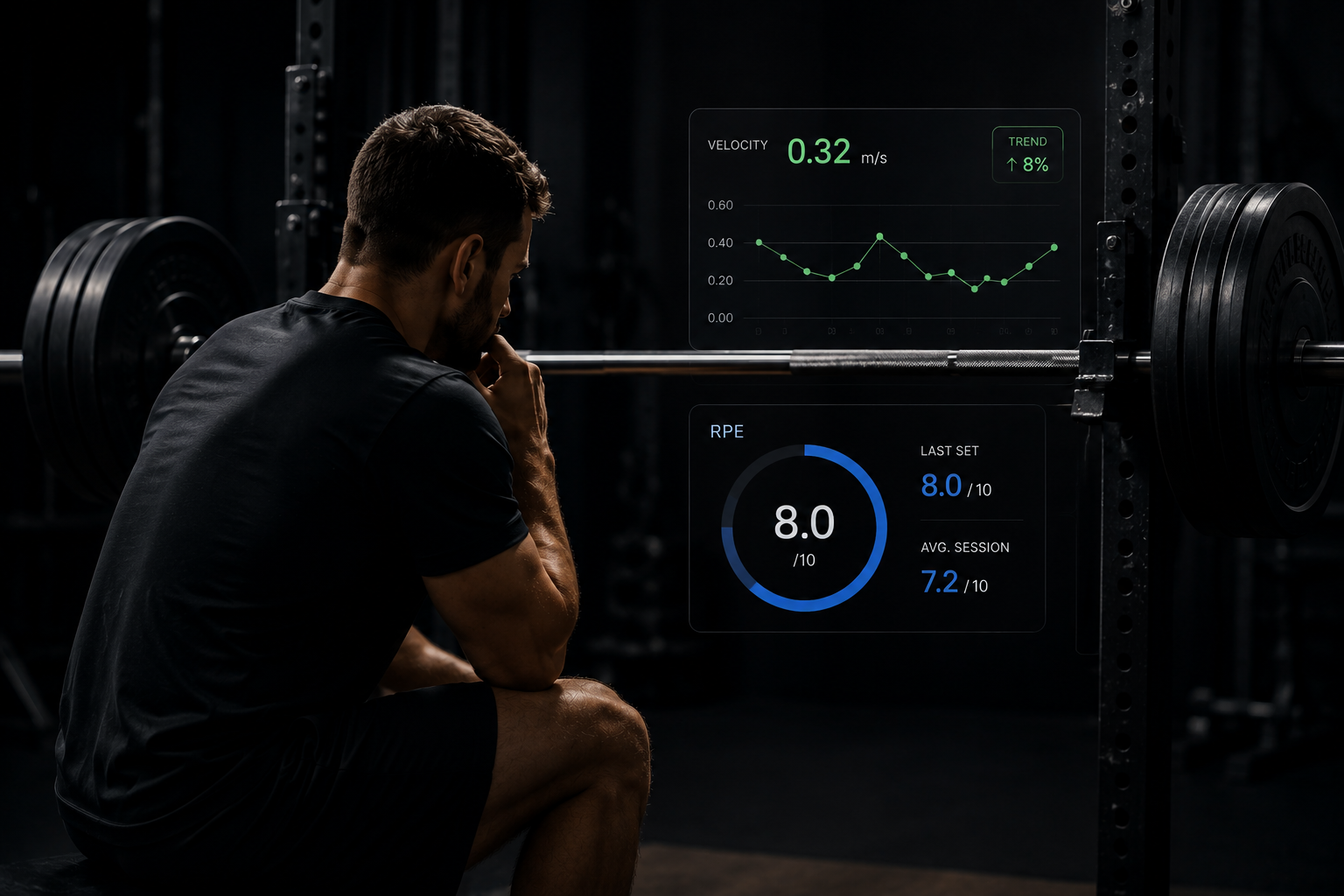
RPE helps explain how hard the work felt to the athlete in the context of that day. Velocity helps explain how fast the load actually moved and how performance changed rep to rep or set to set. Both can be useful. Both can be misleading. And neither becomes automatically better just because it looks more scientific or feels more intuitive.
For most powerlifting coaches, the real question is not which one wins. It is which one is more useful for the decision in front of you.
Why this comparison matters
In powerlifting, a coach is constantly managing uncertainty.
How heavy should today’s top set be? Is the athlete actually ready for the planned work? Did the session create the intended stimulus, or did it create more fatigue than expected? Those are not abstract questions. They shape programming quality, athlete confidence, and long-term progress.
That is why RPE and velocity matter so much. Both are autoregulatory tools, which means both try to help the coach adapt training to the athlete’s current state rather than forcing every session through a rigid prescription. A systematic review on subjective and objective autoregulation methods found that both kinds of methods can be effective for enhancing maximal strength when integrated into a periodized plan.
The implication is important. Coaches do not need to choose between “feeling” and “data.” They need to understand what kind of information each method adds, where it tends to be strongest, and where it can fail.
What RPE actually measures
RPE in powerlifting is most useful when it is anchored to repetitions in reserve.
That framework, popularized by Zourdos, Helms, and colleagues, gives coaches a practical way to estimate how close a set was to failure while preserving a common language between coach and athlete. It turns “that was hard” into something more actionable, such as whether a triple was closer to RPE 7, 8, or 9 and how much room was likely left in the set.
That is valuable because RPE captures the athlete’s lived experience of the set. It reflects how the load behaved in the body actually lifting it, on that day, with that level of fatigue, confidence, soreness, and readiness. In that sense, RPE is not merely a substitute for better data. It is a form of data that no bar-speed device can provide directly.
At the same time, RPE is still perception. Its usefulness depends on athlete education, honesty, and calibration. Some lifters become excellent at it. Others consistently overshoot or undershoot, especially when many reps remain in reserve. Research on RPE and velocity relationships in powerlifters supports the value of the RPE framework, but also reinforces that perception becomes more accurate when lifters are trained to use it well.
Coach’s note
RPE is not weak because it is subjective.
It is powerful because it captures the athlete’s internal reality.
What velocity actually measures
Velocity-based training gives coaches an external performance marker.
Instead of asking the athlete how hard a set felt, it measures how fast the bar moved. That can be used several ways: to estimate relative intensity, to monitor whether a target load is moving as expected, to stop a set after a certain amount of velocity loss, or to track performance trends over time.
This is where velocity becomes attractive. It seems more objective, more repeatable, and less vulnerable to athlete bias. If a load that usually moves at one speed is now moving substantially slower, the coach has evidence that something may be different even before the athlete reports it. Reviews of velocity-based resistance training and critical appraisals of the literature suggest that velocity can be useful for prescribing load, monitoring fatigue, and improving performance feedback when valid tools are used.
But velocity is not pure truth either.
Different devices vary in validity and reliability. Free-weight technique changes can alter readings. Exercise selection matters. Bench press tends to lend itself more cleanly to velocity measurement than deadlift, and even within the same lift, athlete-specific execution can shift the meaning of a given number.
Velocity is objective, but it is still contextual.
Where RPE tends to work best
RPE is often strongest when the coaching question is about adjusting the day to the athlete.
If a lifter is supposed to hit a top triple at RPE 8, that prescription already includes flexibility. The exact load can rise or fall based on how the athlete is performing. That makes RPE highly practical for coaches working in real environments where stress, recovery, travel, bodyweight fluctuations, and meet proximity all affect how the same percentage feels.
RPE is also useful because it does not require hardware. A coach with twenty athletes can apply it immediately across every session, whether the team trains in one gym, several gyms, or entirely remotely. That scalability matters more than many discussions admit.
It is especially effective once athletes understand the language well. When a lifter consistently rates effort accurately, RPE becomes one of the fastest ways to control top-set loading, back-off volume, and general session difficulty without overcomplicating the process.
Practical example
A coach may prescribe a competition squat triple at RPE 8, followed by back-off sets at 72–75% of the top set until the work reaches RPE 8.5. That gives structure, but still adapts the session to the lifter’s actual readiness.
Where velocity tends to work best
Velocity tends to shine when the coach wants a cleaner external check on performance.
This is especially useful when the coach is concerned that perception may be drifting. A lifter might report that a set felt like RPE 8, but if bar speed is meaningfully slower than normal for that athlete and load, the coach has a reason to question whether the internal rating and external output are fully aligned.
Velocity is also especially valuable for within-session fatigue control. The literature on velocity loss suggests that greater velocity loss within a set is associated with greater acute neuromuscular, metabolic, and perceptual fatigue, which makes it a useful way to manage how much cost the session produces.
That does not mean every powerlifting coach needs to run a full velocity-based system. It does mean that coaches who want better control over bar-speed targets, set termination, or performance feedback may get meaningful value from velocity measures when the setup is reliable and the team can actually use the data well.
Summary box
Velocity is often most useful when the coach wants to answer two questions:
- Is the load moving the way it should today?
- How much fatigue is accumulating inside this set or session?
Where both methods fall short
The biggest mistake in this conversation is assuming that the weaknesses of one method automatically prove the superiority of the other.
RPE can be noisy because athletes vary in awareness, honesty, and experience. Velocity can be noisy because devices vary, exercise technique varies, and not every lift is equally easy to monitor. A coach can over-trust athlete perception. A coach can also over-trust a number on a screen.
This matters because both methods can create false confidence. An athlete can report a clean RPE 8 while actually being off by a full rep or more. A velocity device can give a seemingly precise number that the coach interprets too rigidly, without accounting for technical differences, fatigue state, or whether the measurement conditions were actually consistent.
In other words, neither method removes coaching judgment.
Key takeaway
Better tools do not eliminate interpretation. They raise the quality of interpretation when used well.
What the research supports most clearly
The literature does not support a simple winner-takes-all conclusion.
The systematic review by Orange and colleagues found that both subjective and objective autoregulation methods can be effective for improving maximal strength, particularly when used within a structured training plan ]. That alone should calm down many polarized debates. Coaches do not have to pretend one side works and the other does not.
Research on RPE-based autoregulation shows that perceived exertion can be used not only to prescribe intensity, but also to autoregulate volume inside a periodized program . That makes RPE more than a language tool. It makes it a legitimate load-management system.
At the same time, reviews and critical appraisals of velocity-based training suggest that velocity can improve load prescription, provide useful performance feedback, and help manage fatigue through velocity targets or velocity-loss thresholds, although implementation quality and device validity remain important constraints.
A fair reading of the evidence is that both methods can work. The difference is often less about universal superiority and more about context, coaching model, athlete level, equipment access, and what exact decision is being made.
So what should a coach actually trust more?
If the question is about daily load prescription across a remote roster, many coaches should probably trust RPE more because it is scalable, flexible, and practical.
If the question is about whether the bar is moving as expected or whether fatigue inside the set is becoming too costly, velocity often has the clearer advantage because it adds an external performance anchor.
If the question is about athlete development over time, the best answer is usually both. RPE helps the athlete learn effort, pacing, and self-awareness. Velocity helps sharpen objective feedback and can catch performance changes the athlete may not perceive clearly.
That combination is often where the best coaching happens. RPE explains what the set felt like. Velocity explains what the bar did. When those two signals agree, confidence goes up. When they disagree, the coach learns something useful.
Practical example
If a lifter calls a top bench single RPE 7.5 but velocity is much slower than expected, the coach may not need to panic, but they do need to pay attention. That mismatch can signal poor calibration, hidden fatigue, or a shift in technical execution.
A practical framework for powerlifting coaches
For most powerlifting environments, the most useful system is not RPE-only or velocity-only.
A practical framework often looks like this:
- Use RPE for top sets, back-off regulation, and broad daily prescription.
- Use velocity when available for performance confirmation, velocity-loss control, and trend tracking.
- Use RPE and velocity together when the coach wants to evaluate both internal effort and external output.
- Use neither dogmatically when the athlete, lift, or environment makes the data unreliable.
This layered approach fits the way real coaching works. Some athletes have great effort awareness and no access to velocity devices. Some teams have excellent hardware but athletes who still need to learn how hard a hard set actually is. Some lifts are worth monitoring closely with velocity. Others are easier to manage through perception and performance trends.
Final thoughts
Powerlifting coaches do not need to choose a side in the RPE versus velocity debate.
They need to understand what each tool measures, what each tool misses, and which one best answers the coaching question in front of them. RPE is not inferior because it is subjective. Velocity is not automatically superior because it is objective. Both become useful when they are interpreted in context and tied to a clear programming purpose.
That is why modern coaching systems should make it easy to view multiple layers of training information at once. Platforms such as PowCircle are most useful when they let coaches connect readiness, effort, performance, and training history in one place rather than forcing every coaching decision through a single metric.
References
- Banyard HG, Nosaka K, Sato K, Haff GG. Validity of Various Methods for Determining Velocity, Force, and Power in the Back Squat. https://pubmed.ncbi.nlm.nih.gov/26200138/
- Dorrell HF, Smith MF, Gee TI. Comparison of Velocity-Based and Traditional Percentage-Based Loading Methods on Maximal Strength and Power Adaptations. https://researchportal.northumbria.ac.uk/ws/files/74115787/Comparison_of_the_effects_of_velocity_based_vs_traditional_resistance_training_methods_on_adaptations_in_streng.pdf
- Helms ER, Cross MR, Brown SR, Storey A, Cronin J, Zourdos MC. Rating of Perceived Exertion as a Method of Volume Autoregulation Within a Periodized Program. https://pubmed.ncbi.nlm.nih.gov/29786623/
- Helms ER, Storey A, Cross MR, Brown SR, Lenetsky S, Ramsay H, Dillen C, Zourdos MC. RPE and Velocity Relationships for the Back Squat, Bench Press, and Deadlift in Powerlifters. https://blog.performancelab16.com/optothoa/2023/05/RPE_and_Velocity_Relationships_for_the_Back_Squat.2.pdf
- Guppy S, Brady CJ, Nosaka K, et al. Velocity-Based Training—A Critical Review. https://ro.ecu.edu.au/cgi/viewcontent.cgi?article=4327&context=ecuworks2022-2026
- Jukic I, García-Ramos A, Tufano JJ, et al. The Acute and Chronic Effects of Implementing Velocity Loss Thresholds During Resistance Training: A Systematic Review, Meta-Analysis, and Critical Evaluation of the Literature. https://link.springer.com/article/10.1007/s40279-022-01754-4
- Orange ST, Metcalfe JW, Robinson A, Applegarth MJ, Liefeith A, Jordan AR, Vince RV, Lund JN. Effects of Subjective and Objective Autoregulation Methods for Intensity and Volume on Enhancing Maximal Strength During Resistance-Training Interventions: A Systematic Review. https://peerj.com/articles/10663/
- Weakley JJS, Mann B, Banyard HG, et al. The Implementation of Velocity-Based Training Paradigm for Team Sports: Framework, Technologies, Practical Recommendations and Challenges. https://pmc.ncbi.nlm.nih.gov/articles/PMC8066834/