
Introduction
Managing three athletes is simple.
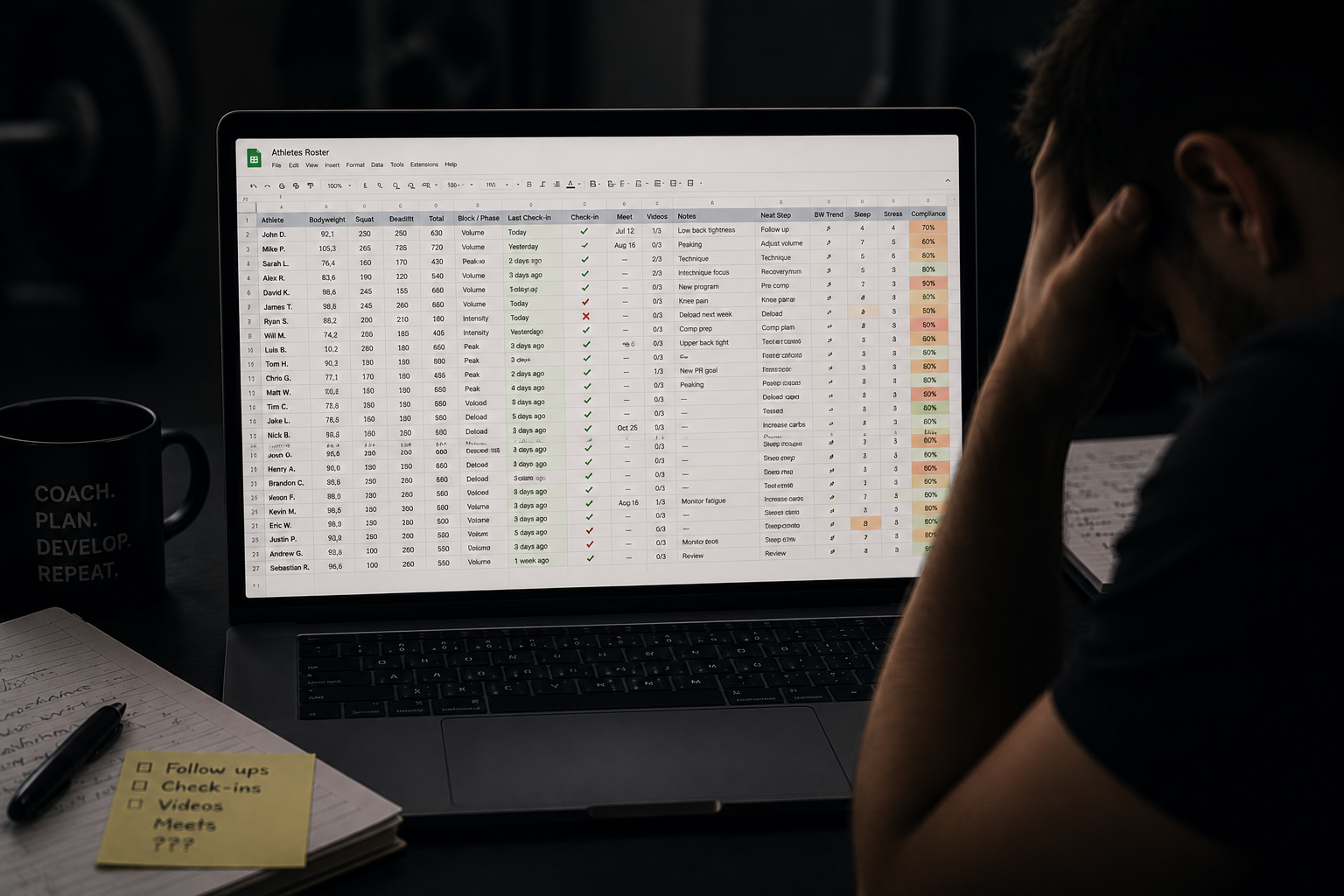
Managing twenty while tracking programming, check-ins, competition prep, training videos, bodyweight, and athlete readiness is a completely different kind of work.
Most coaches do not struggle because programming is too hard.
They struggle because the information required to coach well becomes scattered across too many places.
That is the real scaling problem. Not writing training. Not understanding periodization. Not even communication by itself. The problem is that once a roster grows, the coaching workflow becomes fragmented.
Key takeaway
The problem is not spreadsheets themselves. It is the disconnected workflow that forms around them.
Every coach starts with spreadsheets
Spreadsheets are useful tools.
They are flexible, familiar, easy to update, and easy to share. That is exactly why most powerlifting coaches start with some combination of Google Sheets, Excel, WhatsApp, notes, PDFs, calendar reminders, and scattered video links.
That setup often works well at first.
The issue is not that spreadsheets are bad. The issue is that spreadsheets are rarely the only system. As soon as coaching expands beyond writing sets and reps, information starts living in different tools with no clean center of gravity.
The real problem is the workflow around the spreadsheet
Programming may live in one place, but coaching does not.
Training videos arrive in chat. Bodyweight gets logged somewhere else. Wellness lives inside a form or a message thread. Meet dates sit inside a calendar. Questions about pain, adherence, and fatigue appear across multiple conversations. Nothing is necessarily lost, but everything is disconnected.
That creates friction in exactly the places where coaching quality matters most.
A coach does not just need to know what was prescribed. The coach needs to know what happened, what changed, what needs follow-up, and which athlete deserves attention first.
Why this gets worse as the roster grows
Managing five athletes and managing thirty are not just different in size. They are different operating models.
At a small size, memory can cover for weak systems. A coach can remember who has a meet in three weeks, who missed their last check-in, and who has been dealing with shoulder pain. Once the roster grows, that same approach starts to fail.
Small inefficiencies compound quickly.
The coach begins searching more than reviewing. Follow-up becomes inconsistent. The most visible athlete gets more attention than the athlete who quietly needs help. Communication becomes reactive because there is no reliable way to see the full picture without opening five different tools.
Coach’s note
Coaches do not usually outgrow spreadsheets all at once.
They outgrow the disconnected workflow that forms around them.
What a modern coaching workflow should actually do
A modern coaching workflow should make it easier to coach, not just easier to store information.
That means the system should connect the parts of coaching that are usually separated: planning, programming, athlete execution, readiness, communication, competition prep, and team oversight. The point is not to centralize data for its own sake. The point is to reduce the number of steps between seeing a problem and acting on it.
For a powerlifting coach, a connected workflow should make it easier to answer questions like these:
- Who needs attention today?
- Which athletes are behind on adherence?
- Who has a meet coming up?
- Which lifters are showing signs of fatigue or missed execution?
- Where does the coach need to follow up directly instead of waiting?
Those answers should not require searching through spreadsheets, message history, video threads, and notes.
What usually breaks first
When coaching systems start to strain, the first breakdown is rarely programming quality.
It is visibility.
The coach can still write a block. The athlete can still receive it. But what becomes harder is seeing the operational layer around the plan. Who completed the work? Who is drifting in bodyweight? Who has not checked in? Who is accumulating fatigue? Who is entering meet prep? Who needs a conversation, not just a template adjustment?
This is why the best coaching systems are not really just program builders. They are decision-support systems for a growing roster.
What better team management looks like
Good team management in powerlifting is not about turning coaching into corporate process.
It is about giving the coach one place to understand what is happening across the team. That usually means being able to move from high-level oversight to individual context quickly.
A useful workflow often looks like this:
- Programming is assigned inside structured blocks.
- Athlete execution and daily inputs are tracked consistently.
- Readiness signals such as sleep, soreness, stress, and bodyweight are easy to review.
- Check-ins and comments stay connected to the athlete’s training context.
- Competition prep is visible alongside the rest of the coaching process.
- Athletes who need follow-up are surfaced instead of discovered by accident.
That is the difference between storing coaching data and operating a coaching team.
Why this matters for the coach-athlete relationship
A more connected workflow does not make coaching less personal.
It usually makes it more personal in the ways that matter. The coach spends less time searching, remembering, and reconstructing context. That creates more room for better decisions, better feedback, and better timing.
In other words, structure does not replace care. It protects the coach’s ability to deliver it consistently as the team grows.
Key takeaway
Better systems do not replace coaching judgment. They help that judgment reach the right athlete at the right time.
Final thoughts
Powerlifting has evolved. Programming methods have evolved. Competition preparation has evolved. The systems many coaches still use every day often have not.
Managing a growing roster should not require stitching together spreadsheets, chats, calendars, forms, and memory. At some point, the issue is no longer whether each individual tool works. The issue is whether the workflow between them still does.
That is why connected coaching systems matter. Platforms such as PowCircle are most useful when they help coaches link programming, readiness, check-ins, meet prep, and team visibility into one operating system instead of forcing them to manage the team through disconnected tools.